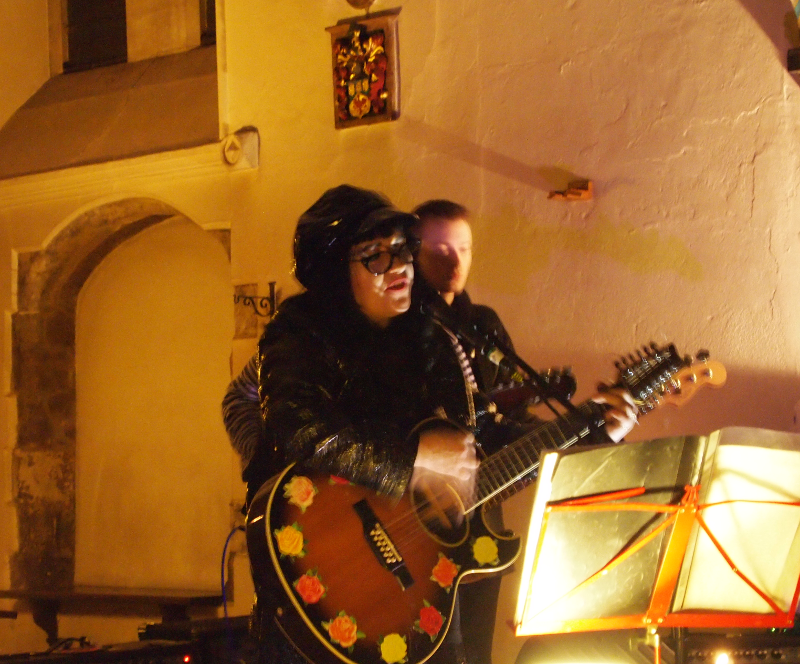

Whilst Matt Pond PA records and live outings have sadly remained largely behind US-based boundaries, the venture has sustained an ongoing durability against the usual odds of the music world, with this year’s new full-length studio set — The Ballad Of The Natural Lines — capturing the latest incarnation of the ensemble in rude health.
Yet even agile peripatetic and restless creative survivors still need to put down sturdy totemic landmarks, to give the loyal faithful a place to return to and for latecomers to use as a starting location – like the ways that Sebadoh brought us Bakesale, Guided By Voices offered up the on-ramps of Bee Thousand and Alien Lanes, Bonnie ‘Prince’ Billy delivered I See A Darkness and Giant Sand gave us Chore Of Enchantment. Matt Pond PA’s main milestone moment is unquestionably 2005’s still-sublime Several Arrows Later. Lovingly self-reissued for its twentieth birthday — with a balancing bonus selection of rarities and attractive acoustic reinterpretations — the album retains a majestic magnetic resonance that this long-time listener has been pulled back to repeatedly and frequently since its original arrival.
Invited into the Freq interview room — via email — between bouts of touring, Matt Pond thoughtfully accounted for the history of Several Arrows Later, the longevity of his lateral artistic undertakings… and more besides.
A perhaps clichéd question to start with. Does it really feel like twenty years since you first released Several Arrows Later?
When I close my eyes, I’m back in Bearsville Studios with Louie Lino and the band. I still live close to where we recorded it, and it feels like I could take a couple of turns and walk right into that moment again. Still, I don’t think I could write that way anymore. It was a chemical reaction between me and New York. Phosphorous and Guinness.
How much do you recall of the headspace that informed the writing for the album and how much can you relate to your younger self in the end product?
It’s probably clearer to me than any other album. I remember writing the motif to “So Much Trouble” on my ex-girlfriend’s Rhodes. I remember coming home from my first Halloween party in New York and writing the song by the same name. Humming “Brooklyn Stars” under the BQE, working out the drum breaks for “Devil in the Water” at Bearsville — counting, laughing, and trying again until we got it right. The person who wrote those songs is still part of me, but I’m not that person anymore. If that makes sense.You’ve never shied away from seasonal thematics with Matt Pond PA, so it seems entirely apt for you to be reissuing Several Arrows Later at this time of year, as it is very much a collection that has the semblance of funnelling itself through the emotions and environments associated with the bridge between summer and winter. Why do you think your songwriting and visual presentations have been so shaped by the seasons?
I spent most of my childhood in the woods. I loved the sound of quiet — wind, branches creaking. That kind of peace felt invincible. My parents divorced and remarried several times. There was a lot of chaos, abuse and isolation. To cope, I tuned out my surroundings and imagined a better world. Because of that, my writing rarely follows the diaristic norm. I gravitate instead toward sensations, scenes and ideas that feel slightly dislocated but emotionally true.
After the arguably less direct albums that preceded it, Several Arrows Later appears to have been forged by a group line-up truly galvanising in democratic fashion, with a lot of creative focus and momentum. Was that the case behind the scenes, from your perspective?
Yes, it was absolutely a group effort — and yes, there was a fair amount of arguing. But I love those kinds of arguments. Eve [Miller; cello, vocals], Brian [Pearl; guitar, bass, wurlitzer, piano, vibes] and I were always trying to articulate the essence of each song. I knew it wouldn’t last forever — we were all strong-willed — but for a while, it was a perfect fire.Do you think ultimately that the relatively unique character of Several Arrows Later comes from a converge of factors at its conception? Such as its time of life circumstances and the particularly strong band line-up that was on hand at the time.
Yes — I do think the albums that really resonate feel like multiple events happening at once. And if Several Arrows Later came out today, I honestly don’t know if it would reach the same number of people.
Were those my best songs? Was that the best lineup? I’m not sure. I loved those people and that moment in my life, but I know so much more about myself now than I did back then. Still, maybe you need a little immaturity to make something great. Maybe that’s part of the spark. It will always be a mystery to me.
The arrangements are deceptively inventive whilst being melodically inviting. For instance, some pieces appear directed by varying combinations of drums, cello and keyboards more than the guitars. Did a lot of thought go into defying conventions or was it just a logical progression on from earlier releases, that had already brought in some of those instrumental elements into the equations?
Sometimes I wish I had a more thorough mind. Other times, I’m grateful for my randomness. There were no grand plans — it all came together naturally. The directions of the songs felt obvious to me as soon as I wrote them. And without needing much explanation, they felt obvious to Eve, Brian and Louie too. I also have to add Dan Crowell [drums, dancing]. He was quiet and stayed out of the arguments, but he grew up playing hardcore in Long Island — he knew exactly how to give the songs momentum.Your musical influences are often not straightforward to spot. Listening and looking back, are you able to trace what might have entered the sonic bloodstream on Several Arrows Later?
Even though Neil Young and Joni Mitchell were my northstar(s), I was pulled in by the music happening around me in New York: The Strokes, Interpol, Yeah Yeah Yeahs. There was a gritty energy in the subways that was impossible to ignore. At the same time, my favorite album from that period was Sumday by Grandaddy. It needed to be playing when I was driving the van.It may be commercially unwise, but I don’t want to be pinned to one genre. I love the strange turns we’ve taken in both music and art. And I’d love to get back to writing prose again. Despite the struggles, I wouldn’t trade lives with anyone — this is who I am.
There is a real dynamic sense of urgency overall, with few slower tempo tracks. What do think gave the recordings such propulsion? Were you philosophically driving away or towards something?
I love running. Even in the city — at any time — I can move my body from point A to point B and experience that nearly unattainable moment between the past and future: the present. Some of my best rhythmic and lyrical ideas come to me when I’m running. And sometimes, I just need to breathe deeply.
The new reissue rewardingly adds in alternative acoustic renderings of most of the LP, which to me celebrate the malleability of the material itself. Were these recorded around the same time as the original released versions or were they recorded more recently?
The acoustic recordings were done over the last year. We tried all the songs to see which ones translated best to acoustic guitar and cello, and this is what emerged. I considered deconstructing the old demos, but I wanted to stay present. In many ways — without altering the core — the songs have evolved, both in arrangement and meaning. I wanted to capture that without making a grand statement. The music is the statement. Hopefully that’s audible.Did the original album tracks go through a lot of iterations before you settled on the ‘final cut’ versions? Could it have been far more of a sedate chamber ensemble affair, had some decisions been different at the time?
We dove into everything and kept throwing ideas at the wall until something felt right. The songs that sounded natural stayed; the ones that didn’t fell away. Eventually, I realised we needed to circle back to the beginning — cyclical, like the seasons.
You’ve also generally not seemed shy of revisiting songs in various incarnations throughout the lifespan of Matt Pond PA. Why do that think that is? Do you consider that some of your compositions lend themselves well to open-ended lives?
I like to think these songs are less cultural snapshots and more part of a long-running collection that lives on its own. My weakness and my strength is that I’ve never fully belonged anywhere. I was an outsider growing up and an outlier at most labels. I love people, I love music — but I also love my own little world and don’t want to compromise it by trying to fit into something that doesn’t feel right.The reissue concludes with a lovely demo of “Closer” that sounds like the version that first appeared on a CD with Comes With A Smile, one of the few UK print publications to have really championed you at the time. Do you view like an orphaned song that hasn’t quite got its due?
When I rehearse that song in the basement, my wife Anya stomps on the floor in response. I loved making that demo. The final album version lost a little of the magic. Some people call it demo-itis. But I think there’s an immediate quality to some of my rough song’s rougher edges that I need to hear and heed. Still, everything happens the way it’s supposed to. The other night after a show, someone told me how “New Hampshire” connected her to her sister who passed away. That’s exactly why I write music.
As such a landmark long-player in your catalogue, do you consider Several Arrows Later to be the record that all subsequent Matt Pond PA releases have had to live up to? Is it your personal favourite?
Emblems is my favourite. That, and the album we did as The Natural Lines. There were no expectations or time deadlines. They became exactly what I wanted them to be. Even with the imperfections — they were intentional.I love Several Arrows Later for the collaboration. Following the release, everyone wanted more from me. I remember playing a sold-out show at The Bowery Ballroom and right before going on, my business manager told me that I needed to start making more money, and soon. It wasn’t an inspiring speech. On a different day, Several Arrows Later is my personal favourite. A part-time Proteus.
Do you have plans for any more archival release projects after the Several Arrows Later reissue campaign is concluded?
I don’t think so. I want to honour the past, but I don’t want to live in it.(I might release a holiday album — combining Winter Songs, Winter Lives and More Winter Lives. I’m lucky that I allow myself to change my mind this much.)

To what do you to attribute the longevity of Matt Pond PA as an entity, through all the shifts in locations, operations, labels and so forth? Has increasingly seeking self-sufficiency been part of the survival strategy?
I don’t totally trust labels — the hierarchies, the lack of transparency. I’m not saying I’d never work with one again, but I prefer owning what I make. That said, I’m exhausted by our last short set of shows — driving, tour managing, shipping albums. I’m not always sure what my job title is or where to focus my energy. In my dream world, I’m writing songs, collaborating, touring, and the world is peaceful and everyone feels loved.The longevity? It’s just the desire to create. I wish it were easier. Then again, friction and songwriting have always been friends.
How do you feel now about your brushes with more commercial attention, particularly surrounding your cover of “Champagne Supernova” for The OC in 2005 and having Starbucks pick up your own “Snow Day” for a TV advert?
Those things helped financially. I never tried to ride the wave for popularity — maybe that was a mistake. Or maybe not. I just never wanted fame enough to chase it.Have you ever been position of being able to give up the day jobs over since starting Matt Pond PA in the late 1990s?
Mostly, yes. I’ve made a living through music. I don’t drive a sports car; I have a modest house I bought before everything became unaffordable. I have a good life through being a dignified drifter. I tour managed for a couple of years, but I don’t love being in service to someone else’s dreams. It allowed me to invest a little more in my music though.
You’ve tried to drop the Matt Pond PA band moniker itself a few times but it keeps coming back. Are you currently at peace with it?
Yes, I’m happily stuck with it. Every time I run away from it, people get confused. And honestly — it’s who I am.
It seems somewhat ironic that the only album that you appear to have had proper UK release for, on Bella Union, was your album under The Natural Lines umbrella. Are you sad or disappointed not have been better known and had more opportunities in the UK and Europe?
I would’ve loved to have done more in Europe, especially the UK. I made The Natural Lines with Bella Union and Simon Raymonde because I admire him deeply. He loved the music, and we all took a risk in a new direction. To me, it was slightly different from Matt Pond PA — domestic subtle-psychedelia, exploring humble life and trying to be a better person without turning into a new age robot.
It didn’t go far commercially, and that’s fine. Someday someone will discover it, and we’ll connect through the cosmos. (I swear I’m not a hippie—I just believe in genuine connection.)
Through MPPA’s existence — and arguably even more so in the last decade or so — you seem to put as much as care and thought into cover versions, one-off singles, EPs, other in-between side-outings and your fun as well as crafted videos, as you do for your self-penned material-led regular albums. Do you think that has helped also played a significant part in keeping yourself and your followers interested, outside more traditional release cycles and so forth?
I don’t know. Sometimes a song says enough on its own, sometimes it takes an EP. What I do know is that I love art projects. I love making things — songs, videos, collections of dreams — I keep pushing myself to crack some unseeable code.For years I avoided social media. I never believed art or music should be treated like something disposable. But this is where people look and listen now. So, I’m giving it a shot for the next few years — not chasing algorithms, not competing with AI or any of it, just trying to see if there’s a way to truly connect.
The most recent new Matt Pond PA album, The Ballad Of The Natural Lines, besides calling back in its title to your aforementioned interim alias, is one of your strongest albums. Are you content with where you are at and the potential for what might come next?
That’s kind. Reading those words makes me think the album connected with at least a few people — you included. I never want to make the same record twice. Right now, I want to push myself with lyrics and odd chords — together. I’m writing a rock and roll album. Something lively, something fun to play onstage. The world feels so strange right now — being overly serious doesn’t feel right to me.-Adrian-
- Matt Pond PA website