
“Music is for me a form of prayer — like an invocation” – Florian Fricke
 There was surely some measure of celestial synchronicity in the lead up to this review. Scarcely eight or nine weeks ago, I was involved in an exchange of messages with our esteemed Editor on the subject of Popol Vuh, one in which I expressed my dawning realisation that “the older I get, the stronger becomes my intuition that greatest of all the 1970s German bands was actually Popol Vuh”.
Having been listening at the time to a lot of Popol Vuh – particularly the majestic Hosianna Mantra i album – it had slowly become clear to me that, despite a true and undying ardour for Can, Faust and the other beloved titans of the ‘new German music’, it was in fact Popol Vuh to whom I found myself returning increasingly often as I grew older.
With each listen something fresh is discovered, some new understanding achieved. As with the latter period Talk Talk, Popol Vuh’s promethean beauty always seems to my elude grasp somehow, a butterfly which refuses to be stuck on a pin, taxonomised and hidden away in a case. Every return is like a first time, a seemingly inexhaustible source of learning and joy.Indulging my early morning messages like Dr Tyrell with the terrified JF Sebastian (“Milk and cookies kept you awake, eh?”ii), the Editor simply replied sagely, “This is wisdom that only the ages can sometimes reveal to an acolyte”.
And now, mere weeks later, Cherry Red have gratifyingly decided to reissue Popol Vuh’s first and fifth albums though their Esoteric imprint, respectively Affenstunde and Einsjäger und Siebenjäger. Divine providence was surely at work here, and so, at the Editor’s request, I will here provide some little written devotion.~
Musically, Florian Fricke, the motive force behind Popol Vuh, was something of a youthful prodigy, having won a number of classical piano competitions by the tender age of fifteen. By the mid to late 1960s, however, his interest was as much with film as with music, having acted as sound assistant on Werner Herzog’s first film, Lebensziechen (Signs Of Life), a study of three World War Two Wehrmacht soldiers gripped by cabin fever as they guard an isolated munitions dump on the Greek island of Kos. Fricke even made a cameo appearance in the film, as a young soldier playing Chopin in an abandoned Turkish mosque.
Concurrently, he was also working as a music and film journalist for Süddeutsche Zeitung, one of the largest and most influential newspapers in Germany, along with other several other high-profile magazines such as Der Spiegel. It was in that capacity that Fricke met Eberhard Schoener, conductor of the Munich Youth Symphony Orchestra. Herr Schoener, as it turned out, had recently taken possession of the first Moog synthesizer in Germany, bought directly from Robert Moog himself in New York, and Fricke was immediately entranced by it, sensing intuitively the huge new vistas of musical possibility which it might open up for him.As Bettina Fricke (als Waldthausen geboren) – Frau Fricke – recalled:
I think that [this meeting] was the turning point in Florian’s life, the beginning of his comeback into music. The Moog allowed him to create new sound structures, sound paintings alike. It was very different from all he had done and heard before. Florian, together with his friend Frank Fiedler, worked day and night – two obsessed magicians, following a vision. And, fortunately, we had some money from a legacy to buy the Moog.
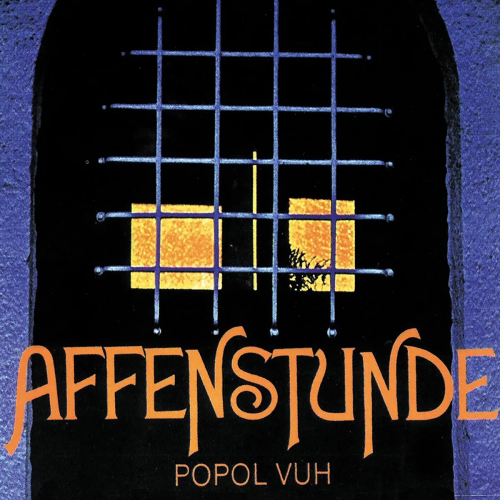
The first results of this feverish vision emerged only a year later in the shape of Popol Vuh’s 1970 debut album, Affenstunde (Ape Hour or The Hour Of The Monkey, depending on your preferred translation), recorded in Munich and issued on the Liberty label. According to Fricke, the title referred to that moment at which the ape takes its definitive evolutionary step, ceasing to be a monkey and instead becoming a human being, an idea influenced by Stanley Kubrick’s then-contemporary space myth, the extraordinary 2001: A Space Odyssey.
The latter description is indeed no throwaway comparison: Fricke’s deep and abiding passion for the span of world cultures meant that his musical vision, reflecting his reading, was shaped from the outset by a range of global influences from ancient Maya, the Upanishads, Plato and Pythagoras to Egyptian history, Christian philosophy, science fiction novels and fairy-tales. The band’s very name itself was taken from a text recording the mythology of Guatemala’s indigenous peopleiii and here on Affenstunde, too, the first side contains a sprawling, instrumental trilogy called “Ich Mache Einen Spiegel” (“I Make A Mirror”), the title deriving from The Florentine Codex, an exhaustive record of Aztec culture written down in the late sixteenth century.
The freewheeling and creative zeitgeist which allowed the band to explore such an idiosyncratic musical vision, coupled with the OuLiPian constraint represented by their limited musical resources, here produced an album which was, and remains, both simultaneously of its time and yet completely removed from it: Affenstunde is a very long way from the everyday currency of ‘rock music’ as it was understood in 1970.The musical experiments which Popol Vuh pioneered here still sound fresh, exciting and inspirational to those musical seekers looking for a way out of the walled garden. As with their near-contemporaries The Third Ear Band, this is the sound of late-Sixties music slipping its moorings completely and setting sail for destinations unknown.
~
 By the time of Popol Vuh’s fifth album, 1974’s Einsjäger Und Siebenjäger, however, Fricke’s musical approach had experienced something of a volte-face. Sensing that electronic instrumentation had already served its purpose in freeing him from imposed limitations (whether shackles he had placed on himself or those obligated by wider musical orthodoxy), gradually he began to move away from the Moogiv and steer Popol Vuh back towards acoustic instruments: the piano, wind and string instruments, human voices.
Recorded at Fricke’s favoured Bavaria Musikstudios in Munich, Einsjäger Und Siebenjäger is a very different affair to Affenstunde: recognisably ‘composed’, more tightly structured, lighter and airier. Taking its title from two characters found within the Popol Vuh, here the band are found in an all-acoustic format using piano, spinet, guitars both electric and twelve-string, flute and percussion.
The music hovers in a liminal space somewhere between the psychedelic, the progressive, the cosmic and the mystical. One could almost hear Kate Bush’s vocals over the second track, “King Minos”, whilst “Morgengruß” (“Morning Greeting”) has a melody which, after hearing, one finds oneself humming quietly for the rest of the day. Daniel Fichelscher’s guitar work is worth singling out for particular praise, somehow sitting outside the standard rock canon, yet utterly right for the music and with no lack of power or forward momentum, akin perhaps to Mike Oldfield’s playing of the same era.v
~
Tragically, Florian Fricke departed way too early; taken by a stroke at the end of 2001, he died at the comparatively youthful age of only fifty-seven. With the later growth of interest in the ‘new German music’ of the gloriously madcap 1970s, Fricke’s absence from the material world in the twenty-first century perhaps meant that Popol Vuh’s profile did not rise again in step with their peers from the era. Unlike, say, Manuel Göttsching, Fricke was no longer around to tour, play to audiences both new and already-devoted, and garner the recognition he so deserved as one of the pioneers of world music (however much of an ill-fitting term that remains).
Nevertheless, we must remain thankfully that we have access to the band’s outstanding discography, and be grateful to Cherry Red for re-issuing these albums in such splendid packages.Let us leave the last words to Bettina Fricke, speculating on what Florian would be doing musically now had he lived: “[he would be creating] places where people could come together in a peaceful and open way and listen to the music, to recover their souls.”
Amen to that.
-David Solomons-
i The album was a noted influence on Kate Bush during her early teenage years. In an interview in the late 1980s, Fricke stated that Bush had contacted him previously, wishing to adapt and record one of Popol Vuh’s songs. Sadly, being unfamiliar with her music, Fricke declined.
ii I always felt that it was wrong of Roy Batty to kill Sebastian near the end of Blade Runner. As Pris has observed earlier, he is one of the few people to act as a friend to them.
iii Popol Vuh translates as ‘meeting place’ or ‘book of the community.’
iv Fricke would eventually sell the Moog to Klaus Schulze.
v Indeed, Oldfield’s magnificent Hergest Ridge album appeared the same year as Einsjäger Und Siebenjäger.